


Protective Cases


Backpacks
Systems
Displays & Projectors
Printers & Scanners
Storage & Memory
Networking
Components & Accessories
View all
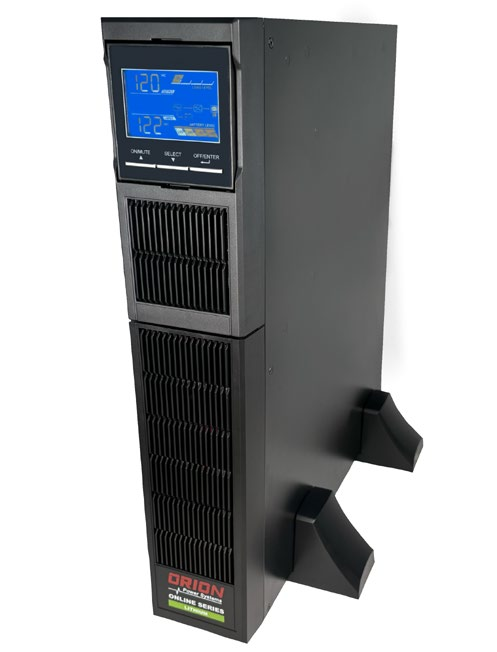
DC1000RTX1
DC1500RTX1
DC2000RTX1
DC3000RTX1
DC3000RTX1HV
DC1500RT1L
DC2000RT1L
DC3000RT1L
DC2000RTXE-1BM
The Orion Online RTX1, Online RT1L and Online RTXE are 2U rack/tower double-conversion UPS systems with near-unity power factor. The difference is the battery. The Online RTX1 uses internal lead-acid batteries and accepts external packs, the RT1L uses internal lithium iron phosphate (LiFePO4) batteries, and the RTXE has no internal battery at all and runs on 1 to 4 external 50Ah lithium packs.
All 3 replace the APC Smart-UPS SRT (and the discontinued SURTA) and the Tripp Lite SmartOnline SU in an MDF, or anywhere power quality matters. Here's how I'd choose.
The Orion Online RTX1 is the lead-acid model with optional battery packs and a 37-month warranty. The Online RT1L swaps in internal lithium batteries, weighs less and carries a 60-month warranty. The Online RTXE is a 2000VA lithium model built only for long runtime, with 1 to 4 external packs and a 60-month warranty.
One thing the spec sheets won't point out: at the same VA, the lead-acid RTX1 is rated for more watts than the lithium RT1L. The DC1500RTX1 is 1430W, while the DC1500RT1L is 1350W. If your load sits near the top of the range, that 80W matters.
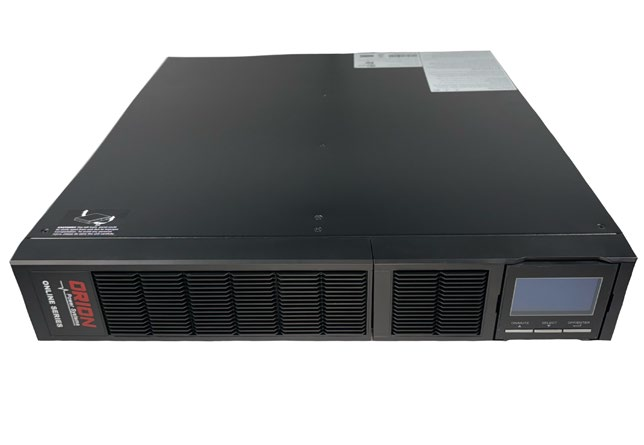
For most school closets, the reason to choose lithium is the warranty and the weight, not the runtime. The Orion DC1500RT1L carries a 60-month warranty on electronics and battery, against 37 months on the lead-acid DC1500RTX1, and it weighs 26 lbs instead of 38. Runtime improves too, but you get minutes, not hours.
Here's the runtime difference at 500W, from Orion's charts:
The warranty is the bigger argument. APC rates the lead-acid battery in its own SRT1500 at 3 to 5 years of life, so plan on buying at least 1 replacement battery for a lead-acid unit you keep 5 years. On the RT1L, a battery that fails inside 60 months is Orion's to replace.
Lighter also matters if the UPS is going into a wall-mount rack: 26 lbs instead of 38 at 1500VA, and 46 lbs instead of 65 at 3000VA.
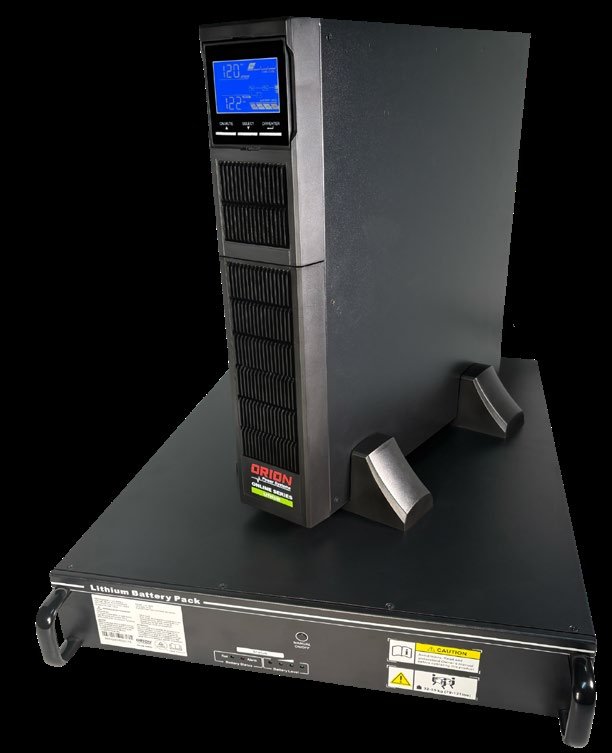
The Orion Online RTXE is the long-runtime model. Per Orion's chart, a DC2000RTXE with 1 lithium pack runs a 900W load for about 128 minutes, and with all 4 packs about 518 minutes, which is more than 8 hours. At its full 1800W rating, 1 pack gives 61 minutes and 4 packs give 249.
At a light 360W load (a core switch and a phone system), 4 packs run 1,153 minutes. That's more than 19 hours.
Here's what the RTXE isn't: a UPS with a battery inside. The power module has no internal battery and won't carry a load without at least 1 pack, which is why Orion sells it as kits from DC2000RTXE-1BM to DC2000RTXE-4BM.
Each 48V, 50Ah pack takes 2U, so the 4-pack kit stacks to 10U and 280 lbs. Orion says the lithium packs are UL1973 certified.
If your building has a generator, skip the RTXE. You only need enough minutes for the generator to start, and an RTX1 does that for less rack space.
Both are 2U double-conversion UPS units in the 1500VA class with external battery support. The Orion DC1500RTX1 is rated 1430W to APC's 1350W, has 8 outlets to APC's 6, and covers the battery for 37 months where APC covers it for 2 years. Orion's lithium DC1500RT1L extends that coverage to 60 months.
If you're replacing an APC SURTA1500, APC discontinued it in 2021 and names the SRT1500RMXLA as its replacement. That's the comparison to quote against, even though Orion's own cross-reference chart still lists the SURTA.
For a fair comparison: Tripp Lite does sell a 1500VA lithium UPS with a 5-year warranty, the SMART1500RM2UL. It's line-interactive, though, not double conversion. If you need double conversion on lithium, compare against the RT1L.
Yes, one. The Orion DC3000RTX1HV is a 3000VA/3000W double-conversion unit with an L6-20P input and 8 C14 plus 1 C20 IEC outlets, for server racks with 208V power supplies. Above that size, Orion's Online SCR3 covers 6kVA and 10kVA at 208/240V.
All 3 lines take the same SNMP card, environmental probe and rail kits as the Network Pro RTX2, and all 3 can be watched from Orion ViewPoint IQ. To see how they fit the rest of the Orion line, go back to our Orion UPS vs APC and Tripp Lite guide.
What's the difference between the Orion RTX1 and RT1L?
Battery chemistry and warranty. The Online RTX1 uses lead-acid batteries, accepts up to 4 external packs and carries a 37-month warranty. The Online RT1L uses lithium iron phosphate batteries, weighs less and carries a 60-month warranty on electronics and battery. Both are 2U double-conversion units.
Does the Orion RTXE have internal batteries?
No. The RTXE power module has no internal battery and needs at least 1 external lithium pack to carry a load. That's why Orion sells it as kits, DC2000RTXE-1BM through DC2000RTXE-4BM, with 1 to 4 packs. Each 48V, 50Ah pack takes 2U of rack space.
How long does the Orion RTXE run at half load?
About 128 minutes at 900W with 1 lithium pack, per Orion's runtime chart. That rises to roughly 258, 388 and 518 minutes with 2, 3 and 4 packs. At a light 360W load, the 4-pack RTXE runs for more than 19 hours.
Which Orion UPS replaces an APC SRT1500RMXLA?
The Orion DC1500RTX1. Both are 2U double-conversion units with external battery support, but the DC1500RTX1 is rated 1430W to APC's 1350W, has 8 outlets to APC's 6, and its warranty covers the battery for 37 months instead of 2 years. For lithium, choose the DC1500RT1L.
Is there a 208V Orion online UPS under 6kVA?
Yes. The Orion DC3000RTX1HV is a 3000VA/3000W double-conversion UPS with an L6-20P input and 8 C14 plus 1 C20 IEC outlets, built for 208V server power supplies. Above 3000VA, Orion's Online SCR3 covers 6kVA and 10kVA at 208/240V.
Are Orion online UPS models TAA compliant?
Orion offers TAA-compliant versions of the Online RTX1 and RT1L. TAA has to be requested when the order is placed, because it isn't the default SKU. Tell us at quote time if your contract or funding source requires it.
Tell me what's in the MDF and how long it has to stay up, and I'll quote the RTX1, RT1L and RTXE side by side. Reach out to sales@9to5computer.com for a quote today!
Contact us to get the best pricing in the industry.


