


Protective Cases


Backpacks
Systems
Displays & Projectors
Printers & Scanners
Storage & Memory
Networking
Components & Accessories
View all
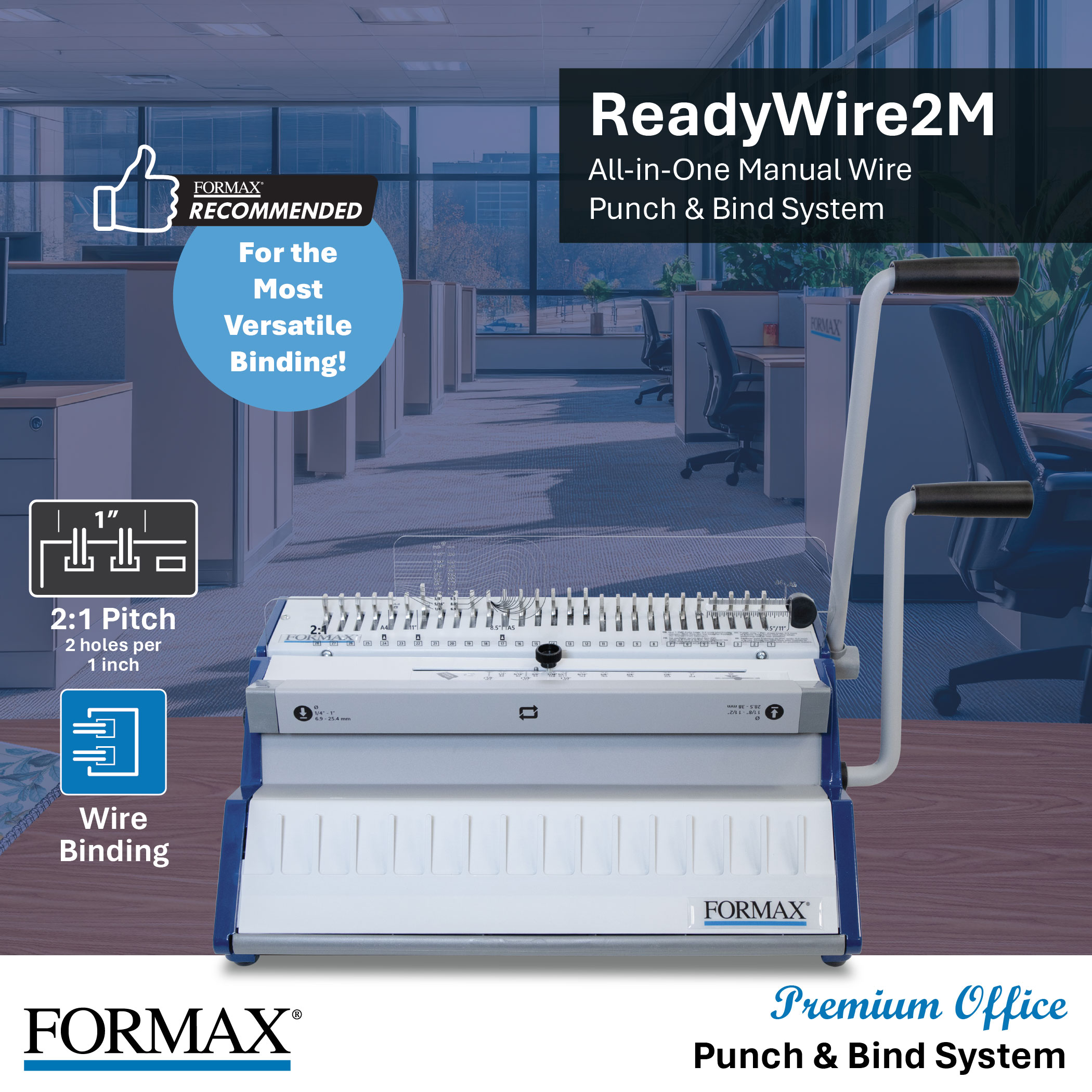
Nine Formax punch-and-bind machines, three binding styles, and the one I'd buy for each room in your district.
This guide to binding machines for schools covers the nine all-in-one punch-and-bind machines in Formax's Ready series that we carry: six ReadyWire double-loop wire models, two ReadyComb comb models and the ReadyCoilM coil model. Every one punches and binds on a single machine. They split on binding style, pitch, manual vs electric, and paper width.
If you only read one section, read the quick pick.
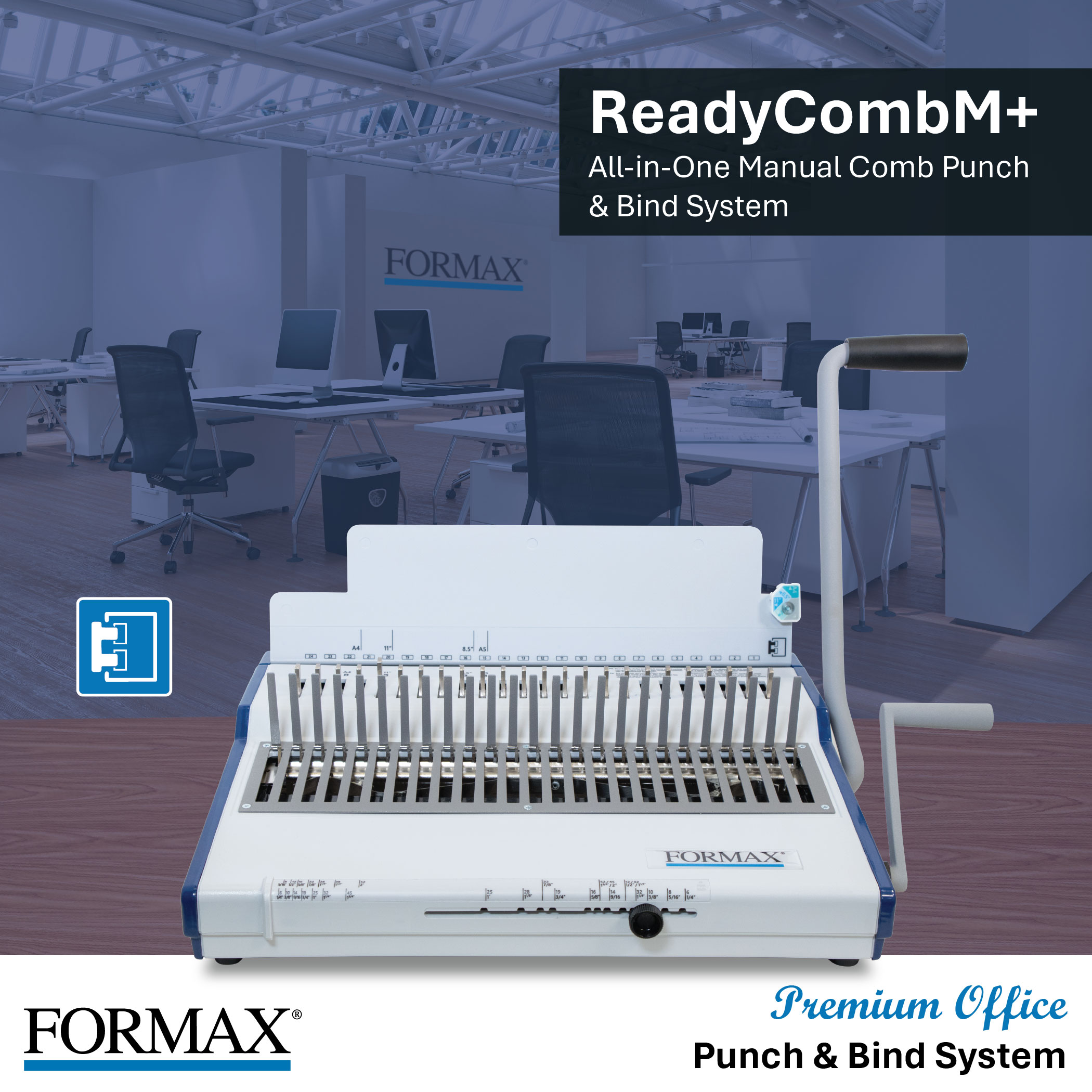
For most schools, the manual ReadyWire2M (2:1 wire) or the manual ReadyCombM+ (comb). The 2M binds legal-size books up to 340 sheets with a clean, lay-flat finish; the CombM+ binds books up to 480 sheets that reopen to add pages. Neither needs an outlet. Go electric only in a print center doing 150+ books a day.
Wire gives the sharpest finish and lies flat; comb reopens so you can add pages and holds the thickest books; coil lies flat, opens 360° and stands up to rough handling, but binds slowest. On Formax's Ready machines, comb holds up to 480 sheets, 2:1 wire up to 340, coil up to 155 and 3:1 wire up to 135.
Comb — Formax's ReadyCombE and ReadyCombM+ close books up to 480 sheets at up to 200 an hour. A comb opens back up on the machine, so you can add a unit or swap a page without rebinding, and Formax says the combs can be reused. It's the workbook and records binding. It doesn't lie as flat, and it looks less finished than wire.
Wire — Formax's double-loop ReadyWire machines close at 200 to 250 an hour and make the most professional-looking book. Formax says its wire "closes in a perfect circle" and opens 360°. Wire doesn't reopen.
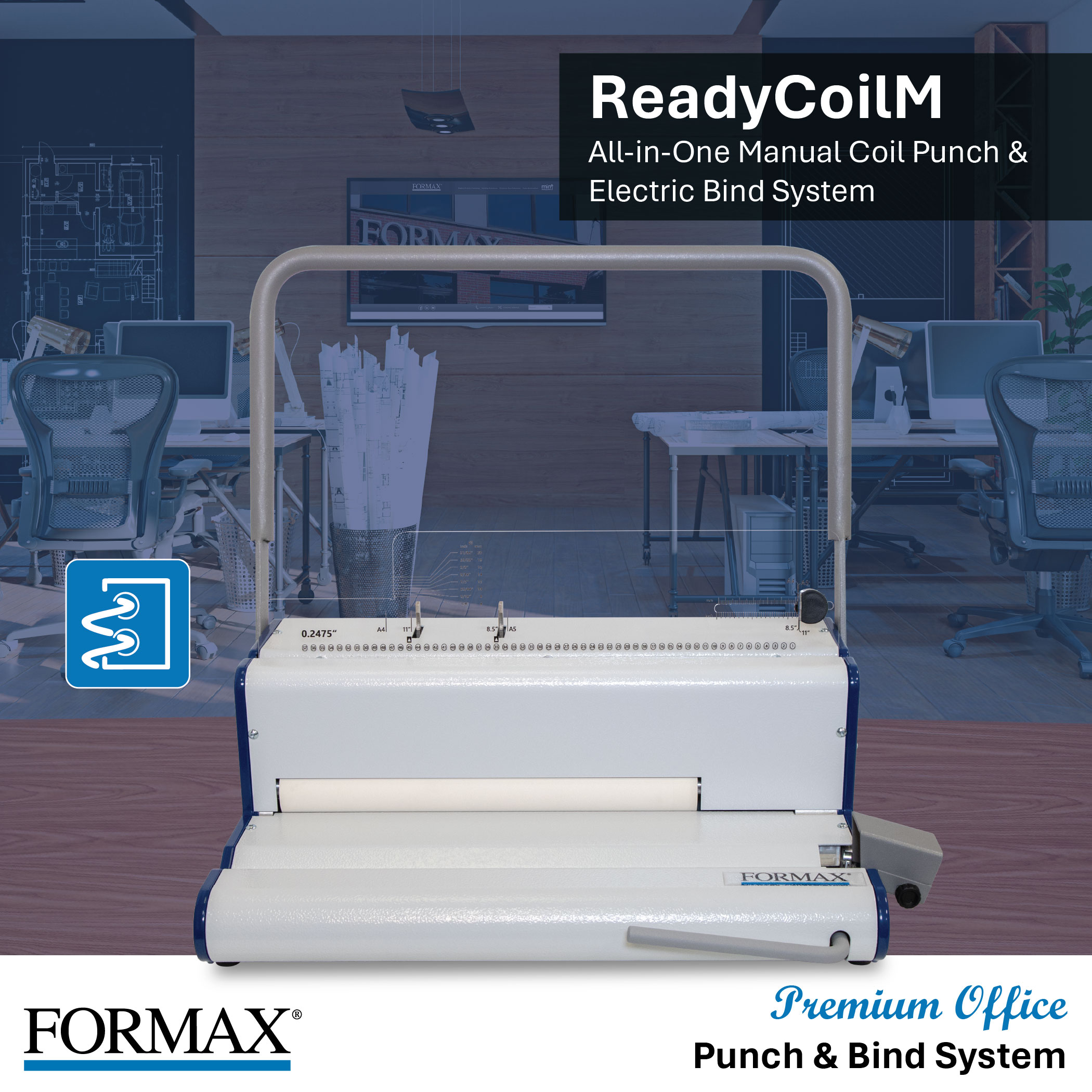
Coil — the ReadyCoilM binds up to 155 sheets at 50 an hour. Formax's pitch is that coil "lies completely flat for easy note taking without losing your spot" and is "durable enough to handle consistent use." Coil is spun on one book at a time, which is why it's a quarter the speed.
Hole spacing and maximum thickness. 2:1 wire has 2 holes per inch and runs up to 1½" diameter, so Formax's 2:1 machines bind books up to 280 sheets (Basic) or 340 sheets (Premium). 3:1 wire has 3 holes per inch and stops at 5/8", which caps Formax's 3:1 machines at 135 sheets.
3:1 looks finer on a thin report. 2:1 handles almost anything. Formax's own graphics for the 3:1 models carry the line "Not sure where to start? 2:1 offers the most binding flexibility!" When the vendor says that on its 3:1 marketing, I'd listen. If one binder has to serve a whole building, make it 2:1.
Only if punching is your bottleneck. On Formax's wire and comb models, the electric part is a foot-pedal punch; the bind still closes by hand lever. The electric ReadyWire2E and ReadyWire3E are rated at 250 books an hour against 200 for the manual versions, and the ReadyCombE punches 16,000 sheets an hour against 12,000.
The comb pair close at the same 200 an hour, electric or not.
The ReadyCoilM flips it. You punch by hand, and an electric inserter spins the coil on.
Below about 100 books a day, I'd buy manual. No outlet, nothing to wire into a workroom, nothing for a sub to troubleshoot.
Formax sorts its wire binders into two tiers. The Basic Office ReadyWire2B and ReadyWire3B take paper up to 11" wide, punch 20 sheets per pass and are rated for 10 to 50 books a day. The Premium models take 14" paper, so legal-size binds on the long edge, and are rated for 100 to 250 books a day.
The Premium machines also add Formax's vertical drop-in punch, punch pins that pull out by hand to avoid half-holes on odd sizes, and an adjustable closure control. All the comb and coil models are Premium.
If anyone in the building binds legal-size on the 14" side, skip the Basic tier.
The nine Formax Ready models range from the 11"-wide, 10-to-50-books-a-day ReadyWire2B and ReadyWire3B to the 150-to-300-books-a-day ReadyCombE. Every figure in the table comes from each model's own Formax spec graphic.
Where a Formax comparison card disagrees with a model's own spec card, this table uses the model's own card. I've flagged those with our rep.
Three other routes come up with districts, and each has a place:
Formax also makes a modular route for print shops: the Punch100 electric punch, with "10 die patterns" and up to "3 binding/closing modules," a 3.5 mm max punch thickness and foot-pedal operation. It pairs with closers like the Comb100 (480 sheets) and Coil100 (155 sheets, manual cutter and crimper). That's the answer when one print center needs comb, coil and wire off one punch. For a single building, an all-in-one Ready machine is simpler.
The machine is a one-time purchase. Supplies are what you keep buying: wire, combs or coils, plus covers. That recurring cost is the number to compare, and it's why I quote a starter supply with every machine.
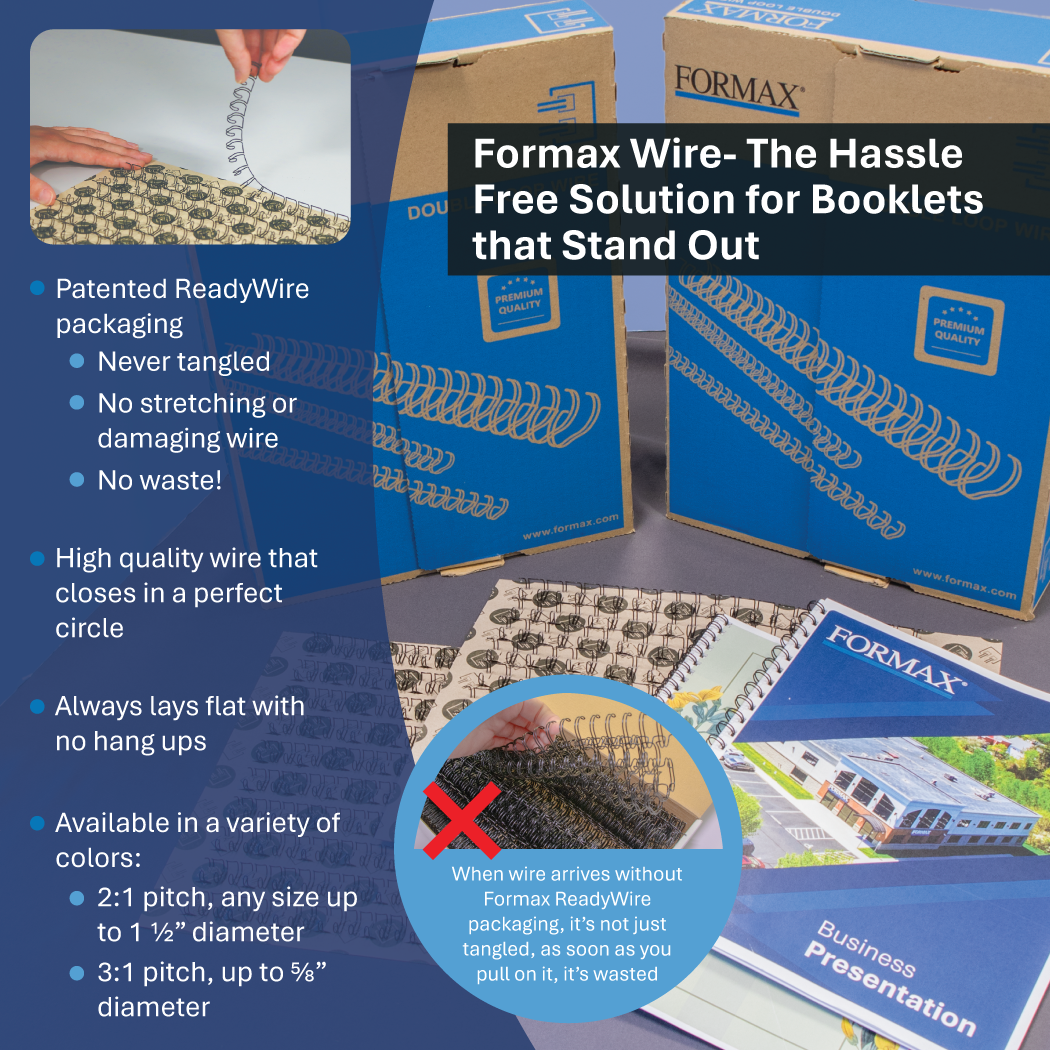
On wire, packaging matters. Formax ships ReadyWire in patented packaging that keeps it from tangling, and its own graphic is blunt about loose wire: "it's not just tangled, as soon as you pull on it, it's wasted." Formax also says ReadyWire runs 10% thicker than industry standard.
No licensing, no subscriptions. Formax backs the equipment with Formax Connect, its own factory support team, which advertises "Year Round, Same or Next Business Day Response."
Tell me which rooms you're outfitting and the rough books-per-week, and I'll put a quote together for the right mix. You can also browse Formax equipment in our store, or see how we work with K-12 districts.
What is the best binding machine for a school?
For most schools, a manual 2:1 wire binder like the Formax ReadyWire2M or a manual comb binder like the ReadyCombM+. The 2M makes sharp, lay-flat books up to 340 sheets on 14" paper. The CombM+ makes books up to 480 sheets that reopen to add pages. Neither needs an outlet.
Is comb binding or wire binding better for student workbooks?
Comb. A comb-bound workbook can be reopened on the machine to add the next unit or replace pages, and Formax says the combs can be reused. Wire looks more finished and lies flat, but once it's closed you'd have to rebind the book to change it.
What's the difference between 2:1 and 3:1 binding wire?
2:1 wire has 2 holes per inch and goes up to 1½" diameter; 3:1 has 3 holes per inch and stops at 5/8". On Formax's machines that means up to 340 sheets on 2:1 versus 135 on 3:1. 3:1 looks finer on thin documents, but 2:1 handles nearly every job.
Do schools need an electric binding machine?
Usually not. On Formax's wire and comb models only the punch is electric, and the electric wire models are rated at 250 books an hour versus 200 for manual. Under about 100 books a day, a manual machine does the job with no outlet and nothing extra to maintain.
Which Formax binding machines handle legal-size paper?
Every model in this guide except the Basic Office ReadyWire2B and ReadyWire3B. Those two take paper up to 11" wide. The ReadyWire2M, 3M, 2E and 3E, both ReadyComb models and the ReadyCoilM all take 14" paper, so legal-size binds on its long edge.
How fast is coil binding compared to wire and comb?
Much slower. Formax rates the ReadyCoilM at up to 50 booklets an hour, against 200 for its comb models and 200 to 250 for its wire models. Each coil is started by hand, spun on by the electric inserter, then cut and crimped, one book at a time.
Are there recurring costs with a binding machine?
Yes — supplies. Wire, combs or coils and covers are the ongoing cost, and there are no software licenses or subscriptions. I'd compare quotes on machine plus a year of supplies, not machine alone. Formax backs its equipment through its Formax Connect factory support team.
Let me know when you have a few minutes to discuss pricing.
Contact us to get the best pricing in the industry.


