


Protective Cases


Backpacks
Systems
Displays & Projectors
Printers & Scanners
Storage & Memory
Networking
Components & Accessories
View all
E-Rate is a federal program that helps schools pay for internet access and the network equipment inside their buildings, and non-profit private and charter schools in Florida qualify. The FCC has USAC run it, and it reimburses 20% to 90% of eligible costs depending on your school's discount.
Florida has roughly 3,250 private schools reporting to the state and about 738 charter schools (2025-26). Plenty of them are eligible and have never applied. We've served schools from Jacksonville Beach since 1991, and I'd like more of them to at least run the numbers.
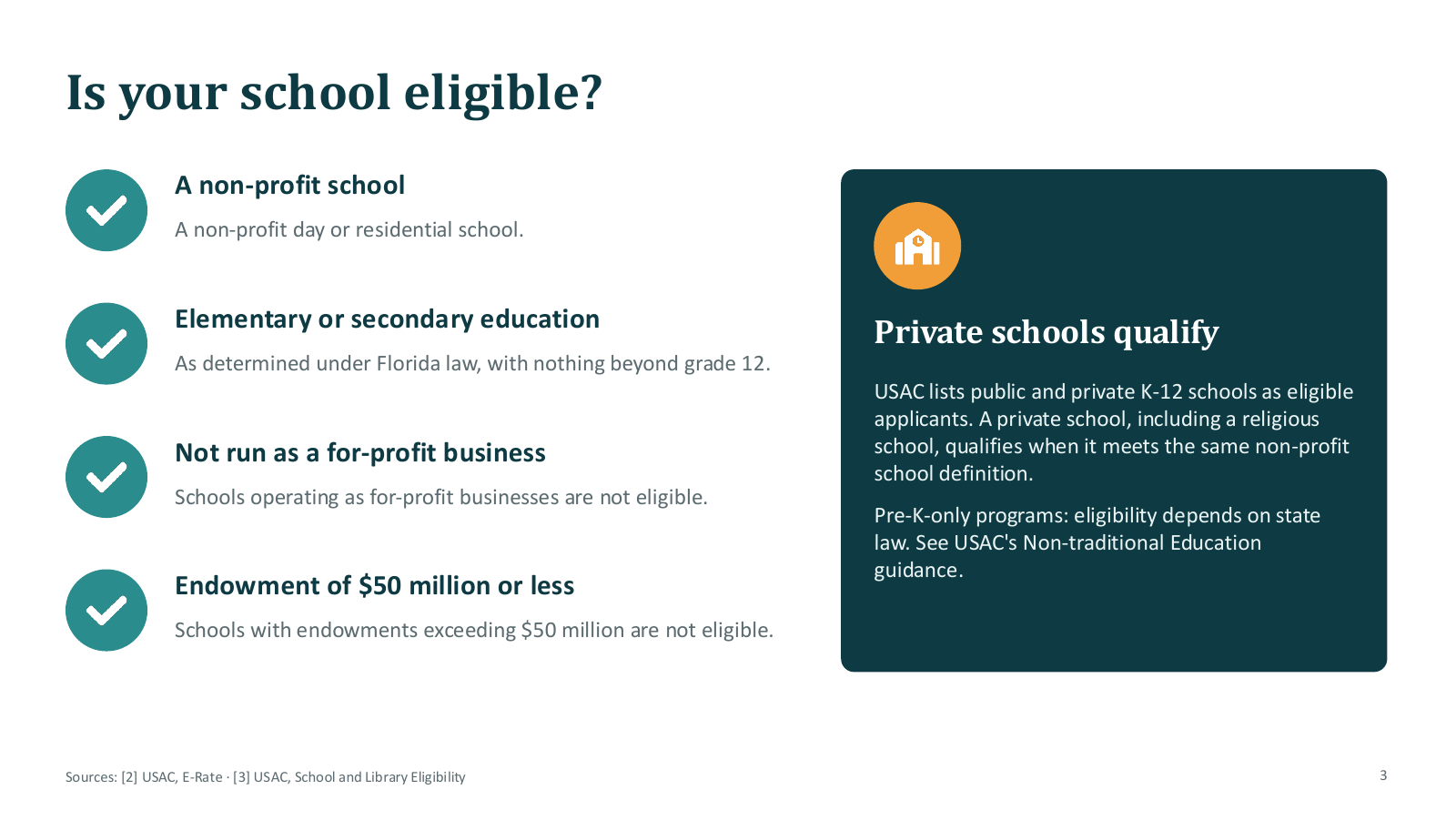
A school qualifies if it is a non-profit elementary or secondary school as defined by state law, with nothing beyond grade 12. Schools run as for-profit businesses, or with endowments over $50 million, don't qualify. Private schools, religious schools included, and charter schools can all apply under that same test. Pre-K-only programs depend on state law.
Pre-K-only programs are different: eligibility depends on state law, so check USAC's Non-traditional Education guidance first.
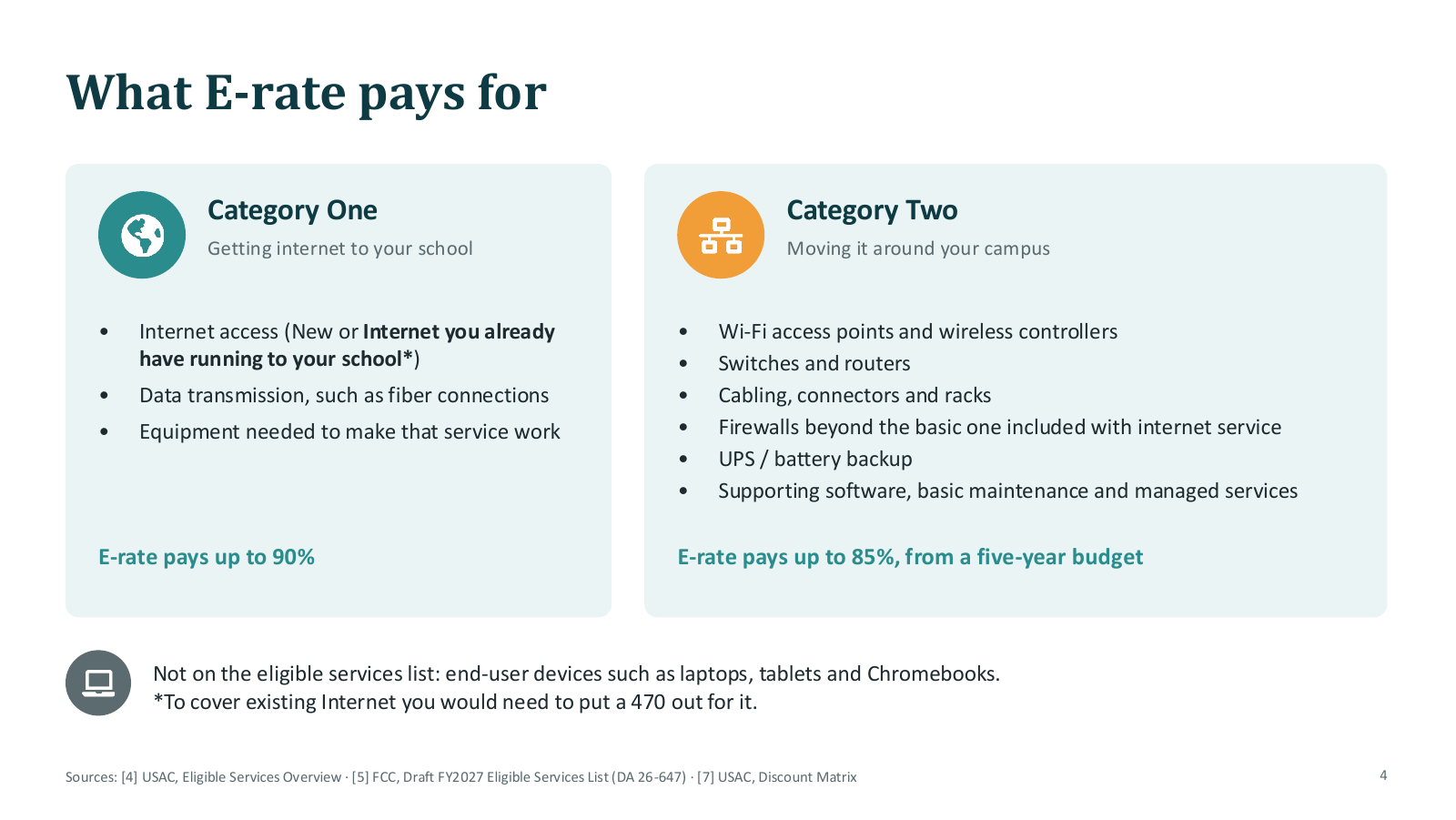
Two categories. Category One gets internet to your school: internet access, data transmission such as fiber, and the equipment that makes that service work. Category Two moves it around campus. From the FCC's draft FY2027 Eligible Services List (a draft, so the final list may differ):
Category One discounts go up to 90% with no budget cap. Category Two goes up to 85%. Laptops, tablets and Chromebooks aren't on the list. We break down the equipment side in more detail in our guide to E-Rate eligible equipment for schools.
Already have internet service? That can be covered too, but you need to post a Form 470 for it.
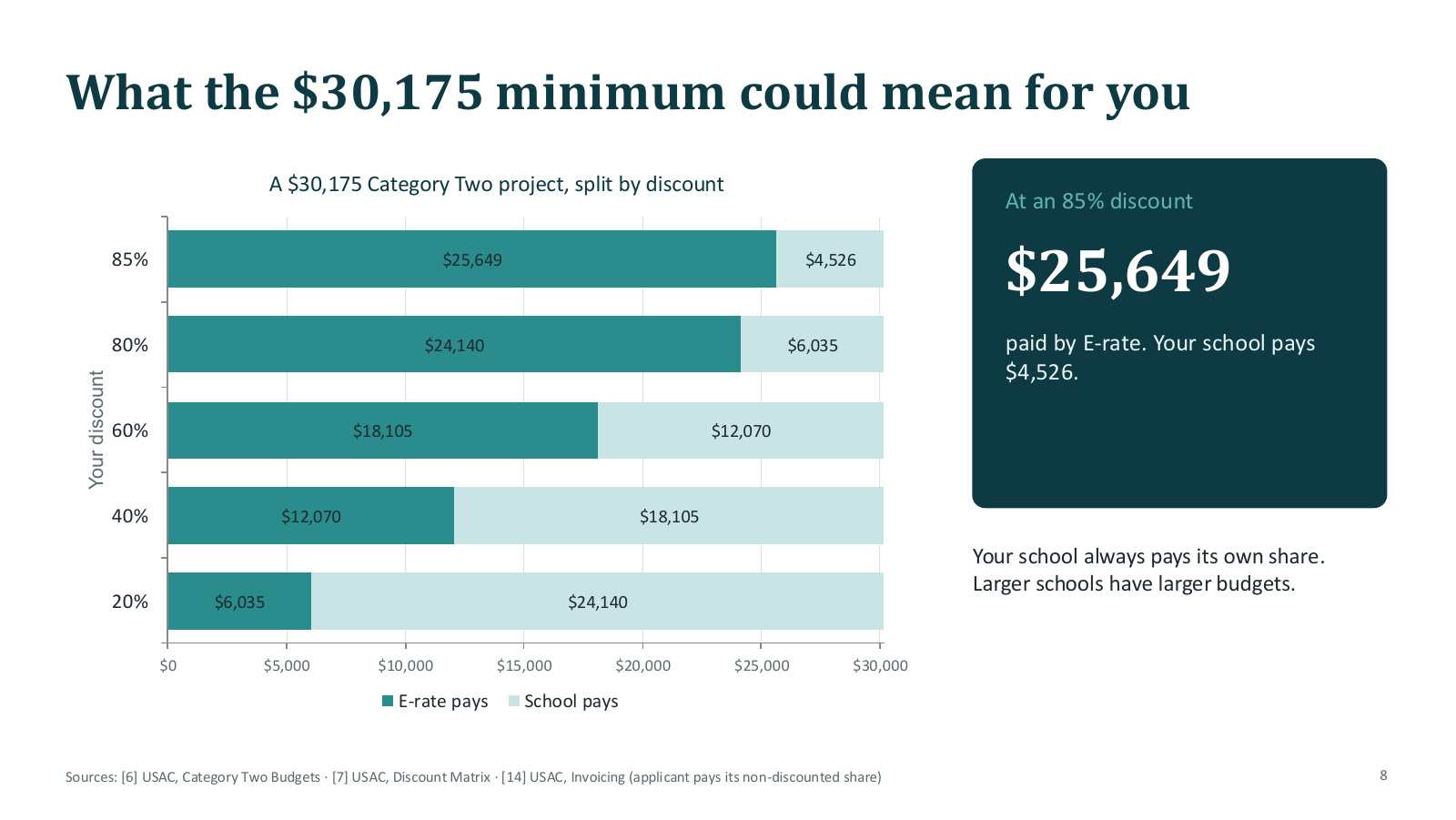
The budget is $201.57 per student with a minimum of $30,175 per school, for the five years from FY2026 through FY2030. Use whichever is larger. Below about 150 students, every school gets the $30,175 minimum.
Here's the part people miss. That budget is the most eligible equipment you can buy with E-Rate's help. It isn't what E-Rate pays. E-Rate pays your discount percentage of what you buy, up to the budget, and anything beyond it gets no help.
You can spread purchases across the remaining years of the cycle, 2027 through 2030 for a school starting now.
It comes from the share of your students eligible for the National School Lunch Program (NSLP) and whether you're urban or rural. Here's the USAC matrix:
No lunch program? You can document eligibility with a family income survey sent to all families, participation in Medicaid, SNAP, SSI, public housing or Section 8, or LIHEAP, or need-based tuition assistance at or below NSLP income guidelines. USAC doesn't accept extrapolated survey results, TANF participation, Title I eligibility or feeder-school estimates.
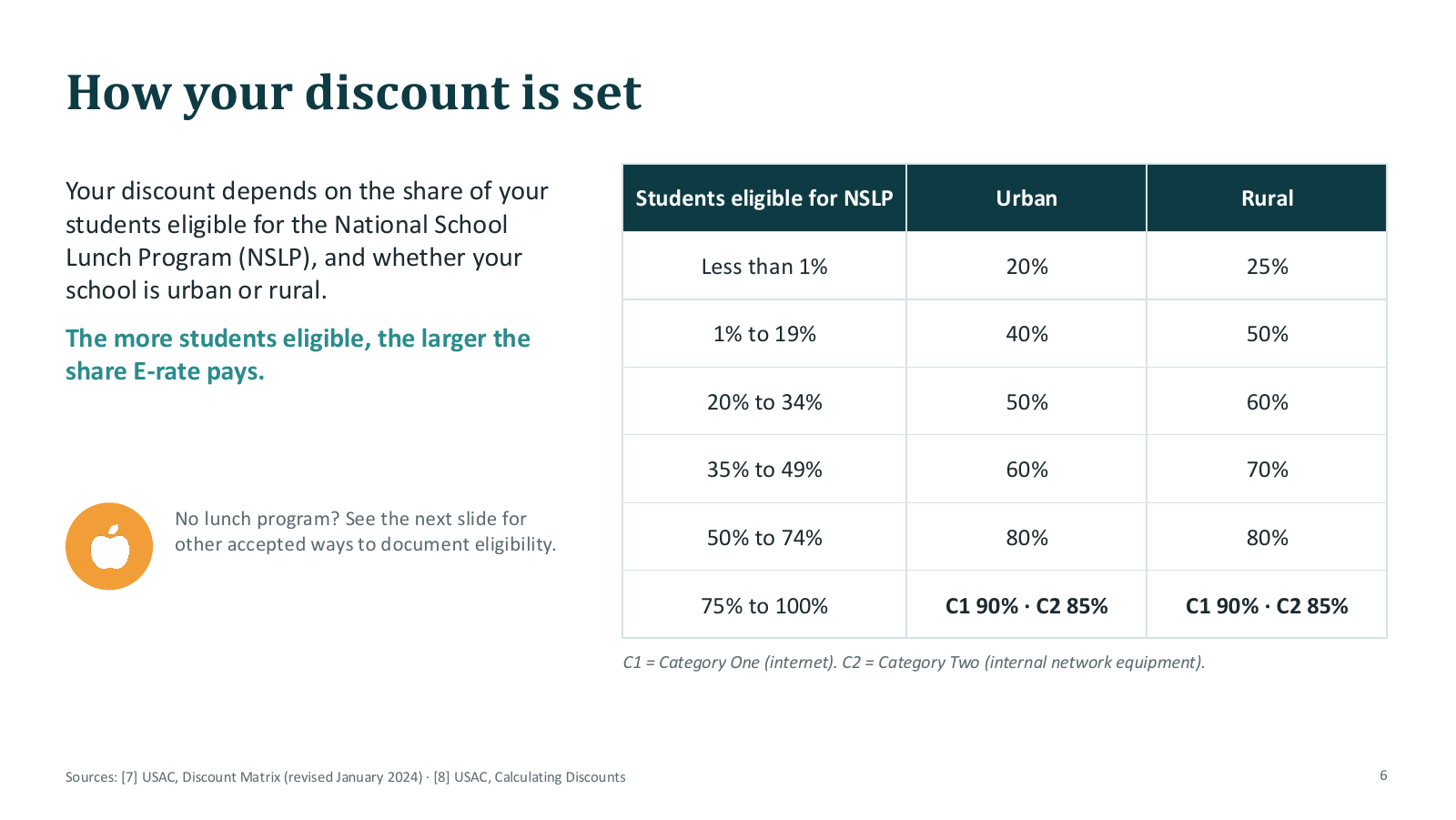
This part is our own rule of thumb, not a USAC rule. Enrollment sets the size of your budget and the lunch percentage sets how much of it E-Rate pays. The sweet spot is a 50% or better discount, which for an urban school means 20% or more of students on NSLP, plus at least $20,000 from E-Rate over five years. That's roughly 200 or more students at 50%+, or a smaller school at 80%+.
A small school at 20% still gets real but modest help, $6,035 over five years, plus its discount on internet service every year with no cap.

FY2027 covers July 1, 2027 to June 30, 2028. USAC's timeline runs like this:
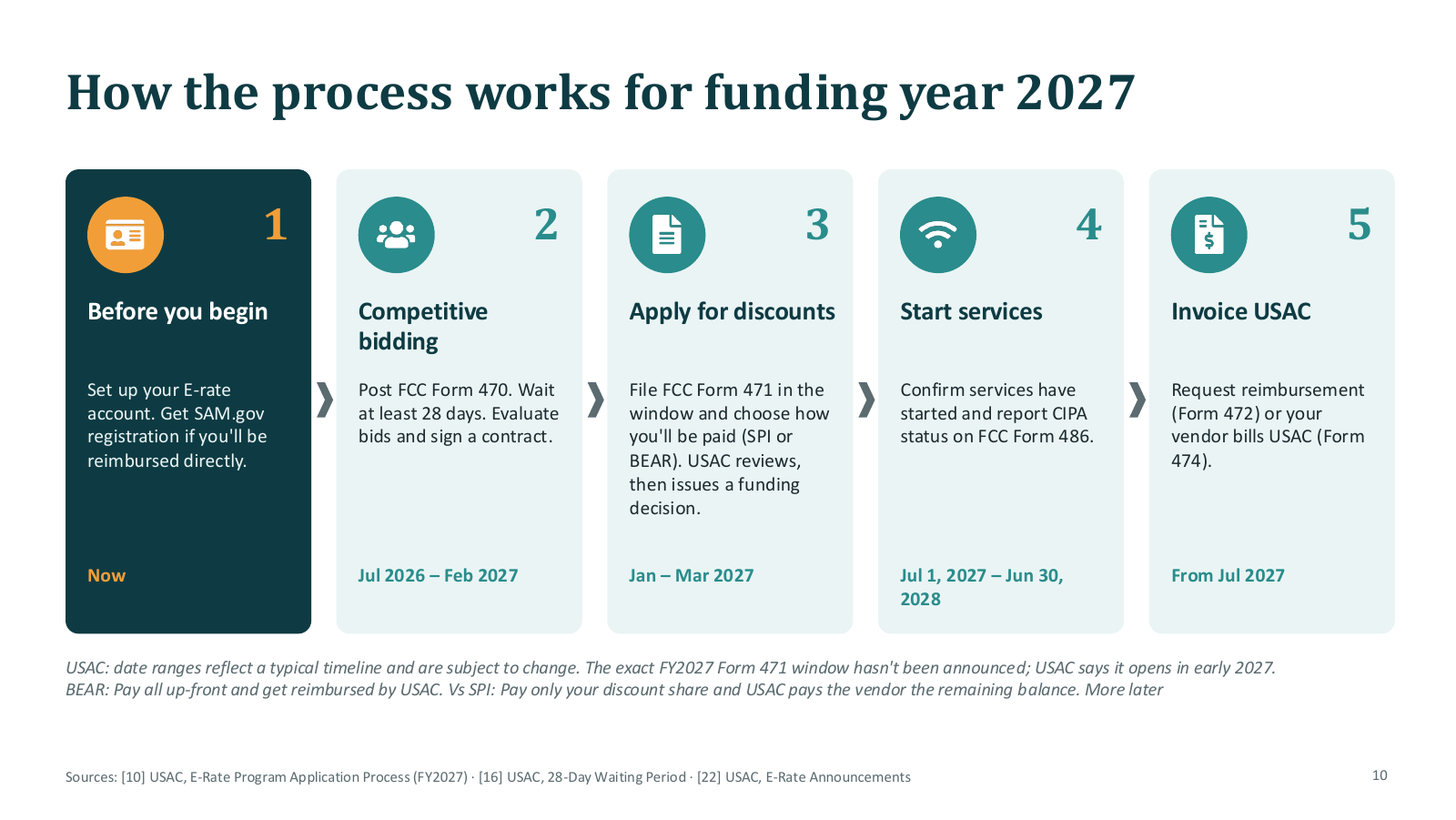
My advice is to post the Form 470 by January. Last year the last practical day was March 4, and I wouldn't cut it that close on your first try. USAC says these dates reflect a typical timeline and may change, so check usac.org before you file.

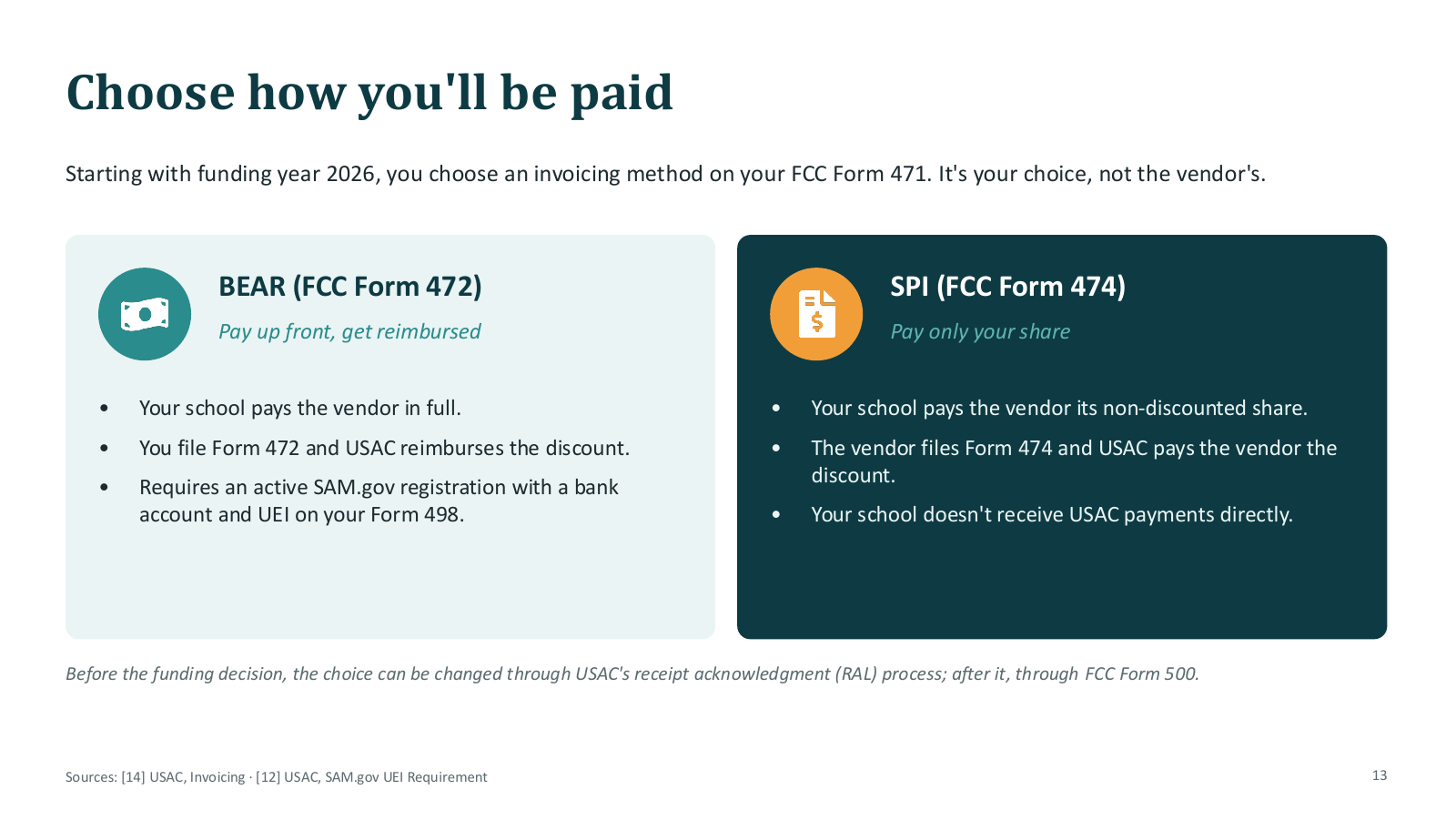
BEAR vs SPI. With BEAR you pay the vendor in full and USAC reimburses the discount, which needs an active SAM.gov registration that can take up to about six weeks. With SPI you pay only your share and the vendor bills USAC the rest. SPI is simpler for most first-timers.
CIPA. Internet access and all Category Two funding require an internet safety policy, a filter on obscene and harmful material, and public notice with at least one public meeting. See USAC's CIPA page.
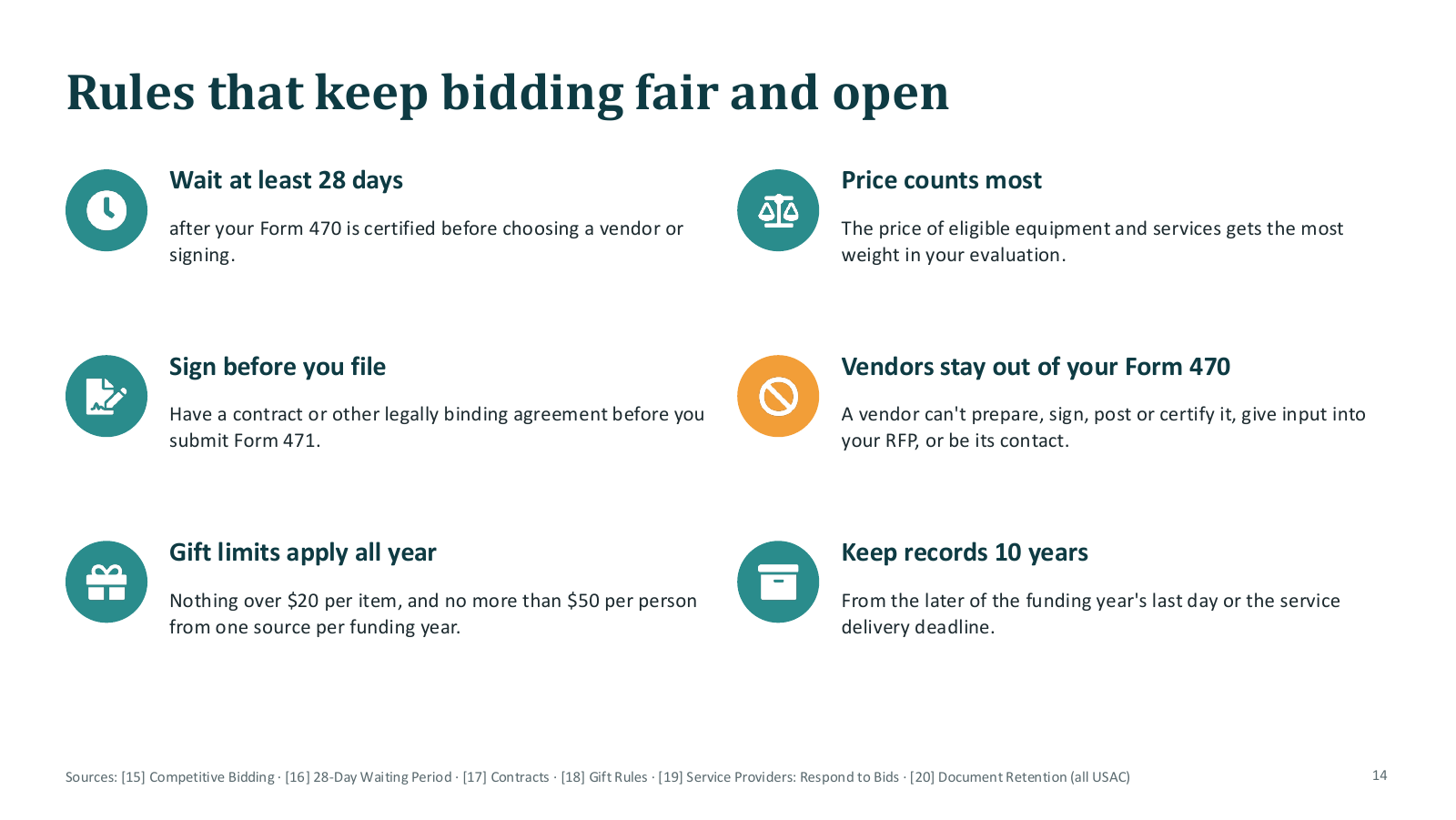
The bidding rules are strict, and they're there to keep it fair. I can explain the program and what's eligible, share technical product information, set up meetings with manufacturers, introduce E-Rate consultants and bid on your Form 470. I can't write or shape your Form 470 or RFP, be its contact, cover your share, or give gifts over $20 per item. Those competitive bidding rules apply all year.
Nothing changes for FY2027. Starting with FY2028, a new USAC bidding portal handles bids and communications, you upload bid evaluations and contracts there, and Form 486 goes away with CIPA certifications moving to the Form 471.
Can a religious private school get E-Rate? Yes. USAC applies the same non-profit school test to every private school, religious schools included. The school must be a non-profit elementary or secondary school under state law, with nothing beyond grade 12, and can't have an endowment over $50 million.
Does E-Rate cover the whole cost? No. E-Rate pays a share of eligible costs, 20% to 90% depending on your discount, and your school always pays its own portion. Vendors aren't allowed to waive or cover that share.
Can E-Rate pay for Chromebooks or laptops? Not on the eligible list. End-user devices such as laptops, tablets and Chromebooks aren't covered. The program pays for internet access and the network equipment that moves it around campus.
How long do we wait after posting the Form 470? At least 28 days after the form is certified. Only then can your school choose a vendor or sign a contract, and you need that contract or binding agreement in place before filing the Form 471.
Do we need an E-Rate consultant? It's optional, though common for first-timers, and the school pays for it. We would highly recommend utilizing a consultant to make the process easier for yourself. We will happily introduce you to consultants who are very well respected.
How long do we keep E-Rate records? Ten years. Keep your bid evaluations, contracts and eligibility documents for that long.
E-Rate pays 20% to 85% of eligible equipment, up to a five-year budget of at least $30,175, and USAC reviews every application, so nothing here is a promise of approval or a specific amount.
Thinking about a first application? Contact us today at 904.891.7251 or at sales@9to5computer.com and I'll walk you through what's eligible. When your Form 470 is posted, we'd welcome the chance to bid. You can also browse our networking catalog or the K12 page.
Want the Full Slide Deck?
Click here for more information if you haven’t issued your form 470.


